Pacific Life: [00:00:00] Welcome to The Wave Strength: Innovative Solutions for a Secure Retirement. Presented by Pacific Life.
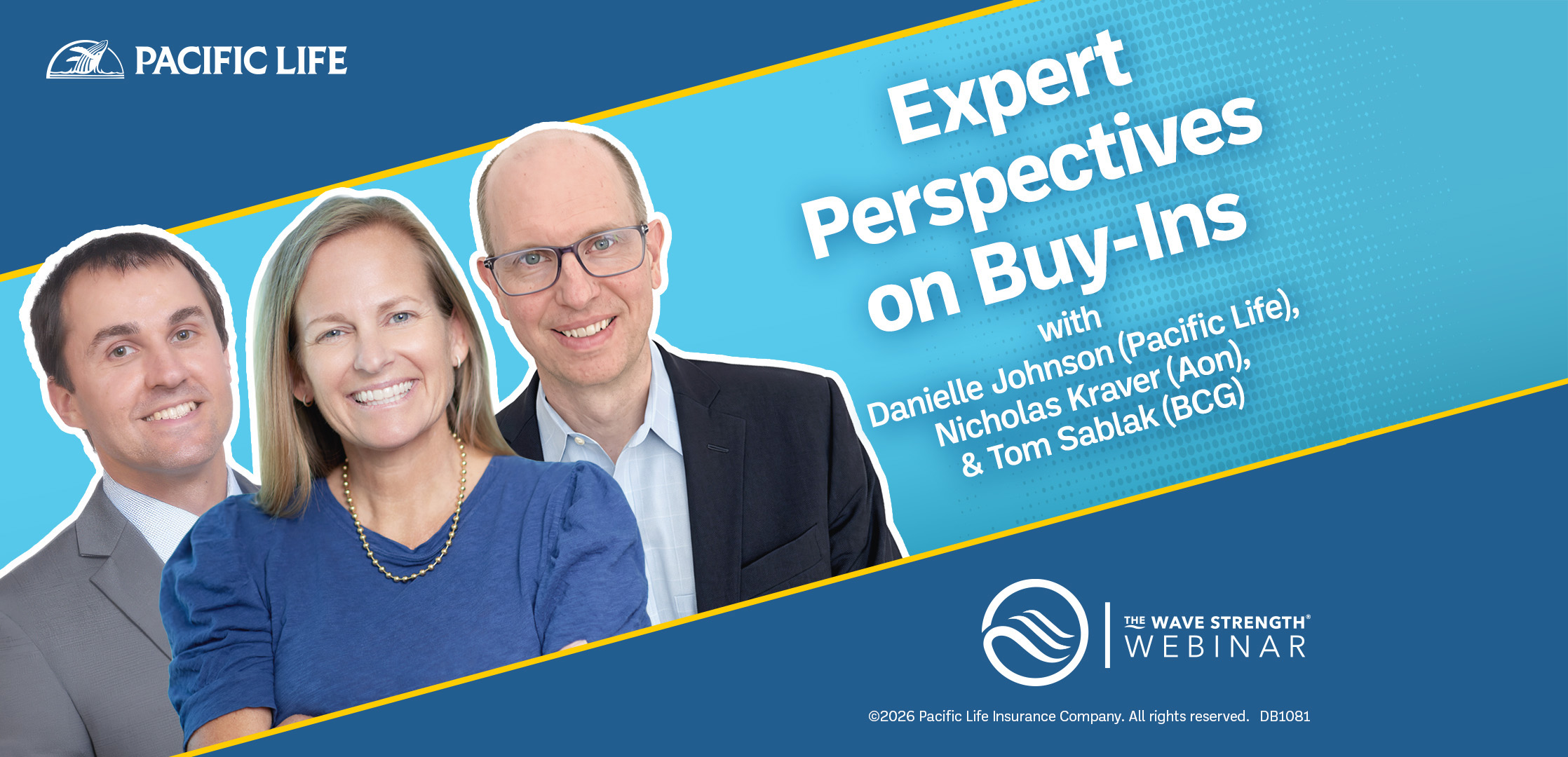
Jim: Hello everyone, and welcome to another exciting episode of The Wave Strength Webinar Series. I'm your host, Jim Breen, Head of Marketing with Pacific Life's Institutional Team. Joining us here today in the studio is Pacific Life's Danielle Johnson, and I want to welcome two virtual guests.
We have Nick Kraver and Tom Sablak. We want to thank you both for being with us today. We're going to have a great conversation today, and, Danielle, what I'd love to be able to do is talk to you and maybe start you off by sharing a little bit about your role with Pacific Life, and then Tom, Nick, we'll get to you next.
But, Danielle, you and I have worked closely with one another for many years at Pacific Life, and maybe for those who are new to the show, share a little bit about your role with Pacific Life and your background.
Danielle: Sure. Thanks, [00:01:00] Jim. It's an honor to finally make it to studio with you today, and I'm excited to be on panel with our guests today as well.
So again, my name is Danielle Johnson. I am a Senior Retirement Sales External Analyst here at Pacific Life. I started with the company back in 2002, and all of my tenure has been in Pension Risk Transfer. I started out in customer service. Then I transitioned into the sales role here on the Pension Risk Transfer team,
and so I've been doing this a long time. It's near and dear to my heart, and I feel like we're doing some meaningful work, and so that's my role here at Pacific Life.
Jim: Great, Danielle. Thank you so much. And, Tom, thank you so much for joining us here on the show. Perhaps you can start and maybe share a little bit about your role and your background,
and then, Nick, we'll get to you next.
Tom: Sure. Thanks, Jim. Thanks for having me. My name's Tom Sablak. I'm a Consulting Actuary at BCG Pension Risk Consultants and Penbridge. I'm also an enrolled actuary. [00:02:00] I've been working on pension plans for over 30 years. I'm not gonna give you the exact number, but it's north of 30.
During the last half of my career, I've been primarily focused on Pension Risk Transfer. That's annuity buy-outs, plan terminations, buy-ins. Over the past couple of years, I've been involved in several buy-in transactions, some of them quite unique. So I'm happy to be here with you today and looking forward to our discussion.
Jim: Great, Tom. Thanks. We are looking forward to that. Nick, maybe you could share a little bit about your role and your background.
Nick: Thanks, Jim. So I've been at Aon now for about seven years, and I lead our Pension Risk Transfer team here in the U.S. My background is I actually came up through the insurance side, working at a couple of insurance companies and working within their Pension Risk Transfer team.
So I bring a very unique perspective to the consultant side of things with an understanding of how insurers think about these types of risk transfers.
Jim: Danielle, Nick, Tom, great introductions, and let's jump right into it here. A lot to [00:03:00] unpack today in the show. We're talking buy-ins and what is a buy-in structurally.
And so Tom, I'd love to throw the first question to you. Perhaps you can share what changes or doesn't change for the plan with a buy-in.
Tom: Sure. First thing I'll say is a buy-in is a lot like a group annuity buy-out. It's a single premium group annuity contract for a targeted group of participants.
The insurer's assuming the economic risk for making the benefit payments to that group of participants. Economic risk is interest rate risk, investment risk, longevity risk, and so forth. But there are some important differences between a buy-in and a buy-out. For one thing, with a buy-in, the insurer does not make monthly benefit payments to the annuitants.
Instead, the insurer reimburses the pension plan each month, so the plan can make the monthly benefit payments to the participants covered under the buy-in. These monthly reimbursement [00:04:00] payments to the plan, they're called bulk payments, and they're in the exact amount each month that the plan needs to cover the monthly benefit payments to the participants covered under the buy-in.
So think of the buy-in contract as a plan investment. It's a plan investment that hedges the liability for the covered group and the value of the buy-in contract as a plan asset. But technically and legally, it's a revocable plan investment. What that means is that the plan sponsor can surrender the buy-in contract.
But a plan sponsor would rarely, if ever, wanna surrender a contract because they'd have to pay a surrender charge and pay the exit cost. But the fact that the buy-in contract is revocable is very important. It means there's no settlement accounting at the time the buy-in is purchased under U.S. GAAP accounting.
Why not? Because the buy-in is, again, technically revocable, and that means that the [00:05:00] plan sponsor's ultimately responsible for making sure that the participants get all the benefit payments that they are promised under the buy-in contract. So that means there's no settlement. Participants covered by the buy-in remain in the plan's head count and also stay under the plan's liability.
But the liability for the buy-in is offset by the value of the buy-in contract, which is a plan asset.
Jim: Interesting.
Tom: So one other thing is that the plan sponsor, they hold an option to convert the buy-in to a buy-out in the future. So at the time of their conversion to a buy-out, that's when a settlement would happen, and that's when settlement accounting would take place.
But from the participant's perspective, it's business as usual. The plan continues to make the monthly benefit payments. Participants contact the plan for administrative matters. It's only if and when the plan sponsor converts the buy-in to a buy-out in the future, that's when the participants would be notified.
They'd [00:06:00] be told that they're gonna be getting the payments directly from the insurance company, and they would get an annuity certificate from the insurer at that point. That's the high level of what a buy-in is and how it's similar to a buy-out, but some key differences.
Jim: Yeah, key differences indeed.
Key differences indeed. Danielle, anything you'd like to add?
Danielle: Sure. We've partnered with Aon and BCG on multiple buy-ins over the years, and each path has been different for the plan sponsor. And so I would say the two most recent ones, they both were well-funded, but they just wanted to offload. They wanted to lock down the risk.
So it provided a solution for both. But one I would even make a step further is it was more of a paternalistic plan sponsor, and so their end goal was to lock down the risk but also maintain the administration. And from a paternalistic company, they still, there's no change for that participant.
The check still comes from the plan. They don't [00:07:00] even know Pacific Life is involved. And so it's provided a great solution for both our plan sponsors in different scenarios.
Jim: Tom, anything you'd like to add to that?
Tom: That's exactly right what Danielle just said. We've seen buy-ins for organizations like church plans, for example, where they wanna transfer the risk, but they also wanna take care of their former employees.
So under a buy-in, they would continue administering the payments, making the payments directly to the plan participants.
Jim: Interesting. Interesting. Nick, I'd love to ask you a question. Maybe you can share a little bit about your thoughts as to why buy-ins are becoming more popular now.
We see this more and more, with that popularity, what problems are they solving for plan sponsors?
Nick: Yeah. So I think the biggest thing right now is that, as many folks know, with interest rates rising and equity markets up, that the funded status has improved for [00:08:00] many plans.
And so a lot of these pension plans have been either closed or frozen for quite some time. And so as they get to either be close to fully funded or overfunded, the natural question is it time to terminate? Is it time to de-risk and do something about that? And so one of the first questions we often get is how much is it gonna cost?
If we think about the traditional termination of a plan, it might take anywhere from 12 to 18 months, possibly longer if they're waiting for a determination letter from the IRS. And with that traditional process, they don't know the cost until the end of that timeline. And so a lot of plan sponsors, before they decide to move forward, wanna know what is the cost.
And a buy-in is a great solution to be able to understand what is the cost to purchase an annuity and transfer that liability before they've even begun the termination process. And so that really resonates with a lot of plan sponsors that we talk to. I think [00:09:00] what's changed over the last couple of years is that more insurers have developed solutions to meet that demand from plan sponsors.
So if we kinda look back over time, if you had a really small plan, you might be able to purchase a buy-in, but maybe only one insurer was interested in it. It was really, buy-ins had really tended to be more served for the large and jumbo end of the market, at least from a competitive bidding perspective.
And what we've seen is more insurers now offer a buy-in solution, that there's more than half of the market has a buy-in solution today. Insurers have also expanded the capabilities with what they can do in a buy-in. So I know Danielle mentioned that all buy-ins are a little bit unique and have their own path, and that's certainly true.
And we've seen insurers come up with some creative solutions to be able to meet some of the needs from plan sponsors. And I think just experience too, right? The more you do, the more comfortable you get, the more standardized things become. So I think all of those factors have made it a little bit easier on the insurer side where now [00:10:00] as I talk to plan sponsors about what does the market look like, there are a number of clients we're talking to today that, three or four years ago, we would've just said a buy-in's probably not the right fit.
So that dynamic has certainly changed. And then I think the last piece too is that pricing is just really attractive right now in the market. Whether it's a buy-out or buy-in, the pricing is pretty similar, and so again, if we think back to the termination path or maybe someone that's even farther away from termination, being able to purchase to buy-in and lock in the cost today is a great way to be able to do that, rather than waiting 12, 18, 24 months and while we'd like to be able to know what the future is, we don't know exactly where pricing will be.
So it's an opportunity to be able to capitalize on the competitive pricing today.
Danielle: And I would just add, as we continue to educate this market, there's this confidence level now, as Nick alluded to, almost more than half of our competition are now providing this buy-in contract. Back in 2013 [00:11:00] when we launched this here at Pacific Life, we were one of few.
And so there was only a few carriers that the plan sponsors could turn to, by way of our consulting firms. There's more providing it now, and so I would say back in 2013, we launched our first in 2014. We converted our first in 2018, and now we've converted 13 since.
And just this year alone, this first half of 2026, we've seen more RFPs for buy-ins than we did in all of 2025. So there's definitely, I think the education and the market is helping, and the consulting firms are now using this as a tool in their toolkit to just have one more solution.
Jim: Yeah, education is so important. Communication, right? Getting the message out there, helping people understand. So it's so good to hear that the communication, the education is working, and, Nick, as you alluded to, obviously it's working, and it's making a big impact. Tom, anything to add there?
Tom: Yeah. Picking up on Nick's [00:12:00] point about buy-ins and plan terminations, it's really true that the buy-in can be very useful for plan termination cost discovery. Think of a plan sponsor who has a frozen pension plan. The plan's been frozen forever. Maybe there's a high percentage of retirees and beneficiaries in pay status.
They want to go through the plan termination process. They don't know how much the annuity's gonna cost, but the one thing that they know, at the end of the plan termination process, they're gonna be purchasing annuities, and they may not even be offering any of those participants a lump sum opportunity during the plan termination.
So one thing that can be very useful for a plan like that is to have the plan sponsor look into a buy-in, understand what the annuity cost is gonna be, lock it in, lock in favorable pricing potentially, and then march through the plan termination process, on their own timeline.
Jim: Yeah, Tom. Great point.
And that brings us to another [00:13:00] question here. Danielle, I'd like to shift it to you. And from an insurer perspective, what are some best practices when a plan sponsor is considering a PRT buy-in, and what are some of the key items considered when evaluating a buy-in?
Danielle: Best practices, first and foremost, is clean and accurate data.
The cleaner the data and the more accurate, the better pricing our pricing folks can provide. And if the end result is ultimately a buy-out, the cleaner the data is, a smoother transfer when that buy-in happens for the individual at the other end of this. And so those are probably the two most important pieces.
For your second question, I would say there's been an uptick recently in the buy-in offering this lump sum window, and so when we're evaluating the RFPs, that lump sum window is now playing a major role in the buy-in. And so a roadmap, if the plan sponsor is providing a roadmap, [00:14:00] that's key in how we're pricing.
So the clean data, the take rate, the assumptions being used, we'd like to know timing around the lump sum window. Is there a plan to convert? If so, when is that conversion gonna take place? And so the cleaner the roadmap that we receive upfront is, the easier for us to price. And ultimately, at the end of this, we wanna get the best price for the client.
Jim: Yeah, absolutely. Nick, any thoughts on that?
Nick: Yeah. So I think the governance around the buy-ins is incredibly important too. Really getting all of the stakeholders informed and on the same page with moving forward. I think, one of the things we take for granted in the industry is we work with buy-ins and are pretty familiar with them, but for plan sponsors, it might be their first time hearing about a buy-in.
They might have heard about Pension Risk Transfer and understand what a traditional maybe lift out or termination is, but are more unfamiliar with the buy-in. And so there tends, at least I find, that there tends to be more education to explain some of [00:15:00] the nuances with the buy-in. Danielle, you talked through all the features of a lump sum window or not, and how does that work.
It's hard to take a really complex topic and simplify it for someone hearing it for the first time. So I think some of those complexities can be a challenge to explain, but are very important to get buy-in because this is one step in maybe a longer project, whether it's a termination or some other de-risking strategy.
So you gotta understand the solution first, but then there's the bigger picture of how does all that fit in. So I find that there tends to be a lot of getting all of the stakeholders on the same page and comfortable with the process and path that we're about to go down.
Danielle: I agree.
Jim: That makes total sense.
Danielle, any follow-up to that?
Danielle: No, I agree with Nick there. Just aligning all stakeholders, like he mentioned. There's typically four of us that are now part of this transaction, and there's so many moving parts, and especially when it comes time to convert. But in that [00:16:00] buy-in phase, Pacific Life is sending a bulk payment back to a trust, and the trustee is now paying.
So we have to make sure we're aligning and staying and everyone's checking the boxes off each month. As that happens, the reconciliation is happening on a monthly basis. These folks are receiving their payments on time, and so there's just a lot of moving parts, and staying aligned with all the different committees and partners is key.
Jim: Danielle, that's a great point, and it just goes back to what we were talking about before. Open communication, that dialogue is crucial.
Danielle: Yes.
Jim: Nick, I think you were maybe gonna say something.
Nick: Yeah. I'll add one more thing, just around the timing of this. I think a lot of times when we think of the Pension Risk Transfer market, there's usually a surge towards the end of the year.
A lot of that is driven by lift outs trying to get some PBGC premium savings. With buy-ins, there's not as much of a hard deadline to get it done. So I think as we look at buy-ins for our plan sponsors trying to find the right time, I talked about the internal governance and stakeholders to get them all on board, but there's [00:17:00] also the data readiness piece.
So as Danielle said, the data is super important. There's a step to get that ready, to be clean and in good shape to get out to the market. So what's the timing to get the data ready? And then also, what does the insurer market look like? If you're gonna have a pretty complex buy-in in the fourth quarter, there's probably a lot of other lift outs and plan terminations in the market that are equally or maybe a little bit more attractive from an insurer perspective.
So I think it's understanding all of what's going on in the market and finding the right time to bring those buy-ins to market. I know, again, Danielle, you said there's more and more coming, and we see the same thing, but there is some of that balancing act of getting everyone on board internally, making sure we've got the data ready to go, and then making sure it's a good time to strike in the market.
Pricing's attractive, but there are nuances even within the calendar year of maybe more or less opportune times to transact.
Jim: Nick, that's a really good point. Now, Tom, this next one is for you. So from an execution standpoint, what are some [00:18:00] key considerations to keep in mind to ensure a smooth buy-in process?
Tom: Oh, okay. Some of them we've already mentioned, right? For a smooth buy-in process, it really starts with clean data. That's critical for underwriting and pricing. But from the plan sponsor's perspective, it's also important to have clean data to get the best possible price for the buy-in from the insurer.
Nick talked about governance. I think that's also extremely important for a smooth process. It's really making sure that the key parties and stakeholders are all on the same page because as Nick mentioned, especially because a buy-in is a new concept for a lot of people. It's getting finance, HR, on board.
They're gonna determine which participants are included in the buy-in. And then there's the retirement plan committee, plan fiduciaries, maybe counsel. They're the ones that are gonna be vetting the insurers, vetting the financial strength of the insurers, [00:19:00] reviewing the buy-in contract, selecting the insurer, monitoring the insurer while the buy-in is being held because it's a plan investment.
There's also an administration component. It requires close coordination between the administrator and the insurer reconciling the bulk reimbursement payments. We talked about timing. What's the likely holding period for the buy-in? Is it a longer term investment? Maybe conversion to a buy-out is far off.
Maybe it's a shorter term strategy in the case of a plan termination. When will the buy-in convert? And, as Danielle talked about before, how do you incorporate the lump sum window into the buy-in design? And then another thing is accounting. The plan sponsor needs to work with auditors to understand the accounting during the buy-in holding period, what the actuarial liability will be during the holding period, getting the periodic contract values from the insurer.
And then what happens at conversion from [00:20:00] buy-in to buy-out? What's the liability settlement? When is it triggered?
Jim: Tom, that's great. Danielle, do you have anything to add to that?
Danielle: I would just say, as we mentioned in the last question, just aligning all stakeholders, and the ongoing coordination between all parties is essential and crucial actually in this entire process.
And we're tracking change, data changes. We're reconciling each month. We're offering contract values. And so as long as all parties are aligned and coordinating as they should be, then those are just essential steps. And I just would echo what Tom said.
Jim: Yeah. Nick, anything you'd like to add?
Nick: No, I think that the lines of communication are just super important. And again, for a number of parties here, it might be their first time working on a buy-in. So if you think about it, the trustee is gonna be very involved receiving those monthly bulk reimbursements and updating the contract value that's provided by the insurer.
It might be the trustee's first time going through a buy-in. So there's a lot of [00:21:00] education along the way with the different parties that are involved, and not just the plan sponsor, but the administrator, the trustee working through with the insurer, whether there are any intricacies like a lump sum window involved.
There's a lot of nuances that might have to be explained for the first time. So I think those open lines of communication throughout the buy-in process are super important.
Jim: Yeah, fantastic. And, as we wrap up here, what I would love to be able to do is do another round robin and ask each of you a question.
And that question is, if you could leave the audience with one takeaway about how to think about buy-ins, what would it be? And Danielle, I'll start with you.
Danielle: Okay.
Great question. We're all doing meaningful work here, and the buy-in is just another tool in the PRT toolkit that can give the plan sponsor peace of mind.
We have to remember, at the end of this, there's an individual who's worked really hard for retirement, and it's our job to preserve and make sure that [00:22:00] retirement paycheck comes for their lifetime, and if that happens, then we've done our job.
Jim: Fantastic. Fantastic. Tom, how about you?
Tom: Yeah. When I think of a buy-in, I think of it as a plan investment.
It's a plan investment that hedges the liability, and I've heard some people even call it the ultimate liability-driven investing strategy.
Jim: Yeah.
Tom: The ultimate LDI. But even with a very good LDI strategy, right? Set aside buy-in for a second. With a very good LDI strategy, sure, you've mitigated a good chunk of the interest rate and investment risk, but the ultimate effectiveness of an LDI strategy will only be measured and known over time as it plays out.
With a buy-in, you've shifted the risk to the insurer when the buy-in's purchased. There's nothing to wait for in the future to see how it plays out. That risk shift happens when the buy-in is purchased. And the plan [00:23:00] sponsors that I've worked with have generally been very happy with their buy-ins because, number one, it transfers the risk. It transfers the risk on their timeline, but also a plan sponsor will only purchase a buy-in if the price is compelling.
By definition, it's risk transfer at a very good price.
Jim: A great point. Nick, your thoughts.
Nick: Yeah. I know this is a buy-in session, but ... I wanna say just buy-ins aren't necessarily for everyone, right? As we look at every plan sponsor or even every transaction, a buy-in may or may not be the right fit.
And I think it's important to recognize that, especially as consultants in this industry, finding the right solution for the client to make sure it's a right fit, being able to explain and articulate why that is and, from the audience as you're going through this, as a plan sponsor or anyone else, ask questions.
Ask questions if you don't understand something or why something's done the way it is. And I think it's just important to remember that it's a market that's [00:24:00] evolving. Like I said earlier, a couple years ago we might not have talked to certain clients about a buy-in solution because there just wasn't really a practical solution on the insurer side, and that's definitely changed over the last couple years.
And who knows what it will look like in another three or four more years. But I think that's an important piece of this too, is just to understand that, things are evolving as we go.
Jim: Absolutely agree. Nick, Tom, Danielle, I wanna thank each of you for being with us here today. It's been such a fantastic opportunity for us to connect, to learn more about the buy-in, and just to understand you all in general, frankly.
I wanna thank you each of you for being here with us today.
Danielle: Thank you, Jim.
Tom: My pleasure.
Nick: Thanks for having us.
Jim: Absolutely. And, to our audience, I wanna thank each and every one of you for joining us today on another webinar of The Wave Strength series, and I wanna encourage you to head over to YouTube, Spotify, and Audible. Hit Like and Subscribe so that you can stay current with new content as it becomes available.
We'll see you soon, everyone. [00:25:00]
Pacific Life: This has been another episode of The Wave Strength, presented by Pacific Life. Don't forget to catch us on YouTube and make sure to subscribe. Although this podcast is presented by Pacific Life, the opinions and views expressed are those of the hosts and participants and do not necessarily reflect Pacific Life's views on any of the topics discussed.
Unless otherwise noted, Pacific Life is unaffiliated with any other individual or company mentioned. Pacific Life is a product provider. It is not a fiduciary and therefore does not give advice or make recommendations regarding insurance or investment products. Pacific Life, its affiliates, its distributors, and respective representatives do not provide any employer-sponsored qualified plan administrative services or impartial advice about investments, and do not act in a fiduciary capacity for any plan.
Pacific Life refers to Pacific Life Insurance Company and its subsidiary, Pacific Life & Annuity Company. Insurance products can be issued in all [00:26:00] states except New York by Pacific Life Insurance Company and in all states by Pacific Life & Annuity Company. Product availability and features may vary by state.
Each insurance company is solely responsible for the financial obligations accruing under the products it issues.




.jpg)